You have approval to organize the event.
The budget is beginning to take shape.
Then comes an early planning question:
Should we secure the venue first, or develop the event concept first?
There is no universal answer.
But there is something that should happen before either decision.
Start With the Event Objective
Before choosing a ballroom, designing a stage or deciding on a theme, clarify what the event needs to achieve.
Is this an internal company gathering?
A product launch?
An award night?
A conference?
A client event?
An exhibition?
The objective influences the guest experience, program format, production requirements and ultimately the type of venue you need.
Without that clarity, it is easy to choose a venue that looks impressive but creates limitations later.
When Booking the Venue First Makes Sense
There are situations where venue availability is the biggest constraint.
Perhaps the event date is fixed.
Perhaps you need a specific location.
Or perhaps the event will host hundreds or thousands of guests, leaving only a limited number of suitable venues.
In these cases, securing the venue early can be the right move.
But the venue should still be evaluated against the event requirements.
Look beyond capacity.
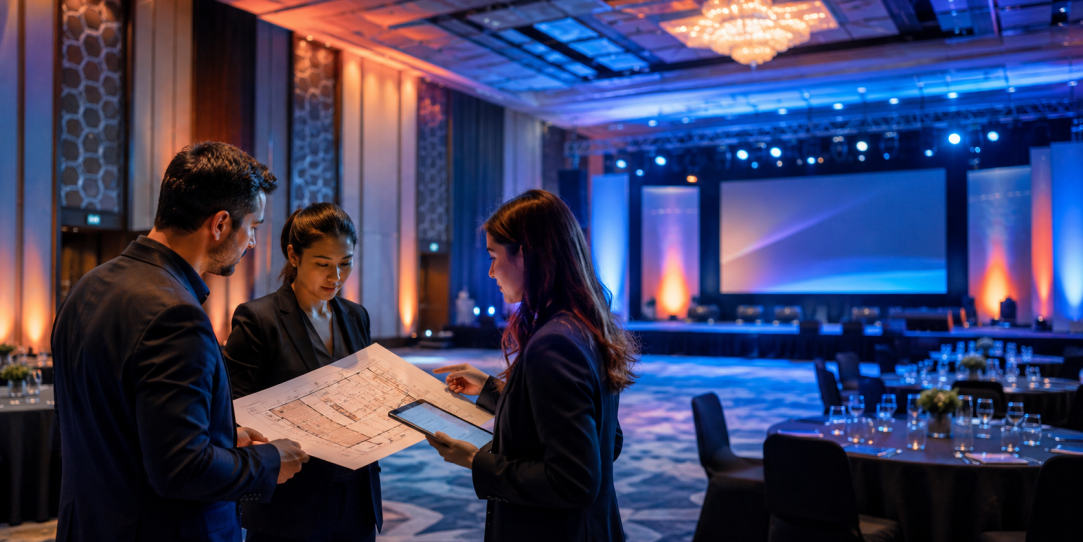
Consider ceiling height, stage area, loading access, electrical capacity, rigging possibilities, guest flow, backstage areas and technical restrictions.
These details can significantly affect what the production team can build later.
When Developing the Concept First Makes Sense
If the event experience itself is the priority, developing the core concept before committing to a venue can create more flexibility.
For example, a product launch may require an immersive installation.
A conference may require several breakout areas.
An award night may need a large stage, elaborate lighting and specific seating arrangements.
Understanding those requirements first allows the venue search to become more intentional.
Instead of asking:
“Is this venue available?”
you can ask:
“Can this venue support the experience we want to create?”
That is a much more useful question.
The Best Approach Is Usually Somewhere in the Middle
In practice, venue selection and concept development often happen together.
A preliminary concept informs the venue search.
Then the chosen venue influences how the concept develops.
This back-and-forth is normal.
Good event planning is rarely a perfectly linear process.
The key is making major decisions while understanding how they affect everything else.
Avoid Designing Something the Venue Cannot Support
One expensive mistake is developing an elaborate event concept before understanding the physical limitations of the location.
A design may require rigging that the venue does not allow.
An LED configuration may not fit.
A planned guest flow may clash with the venue layout.
Production equipment may have restricted access.
Those issues are much easier to solve during planning than during installation.
That is why communication between the client, event organizer, venue and production team should begin as early as possible.
Think About the Event as a System
Venue, concept, production, program, guest experience and budget are not separate decisions.
They influence one another.
Changing one variable may affect several others.
Strong planning is therefore not only about making good individual choices.
It is about understanding how those choices work together.
From Brief to Showtime
At 1188 Production, our process begins by understanding the brief before determining what the event needs creatively and operationally.
From there, we develop the concept, prepare the production requirements and coordinate execution through event day.
Because the right venue matters.
The right concept matters.
But making sure everything works together matters even more.
Have an upcoming corporate event? Request an event proposal from 1188 Production.